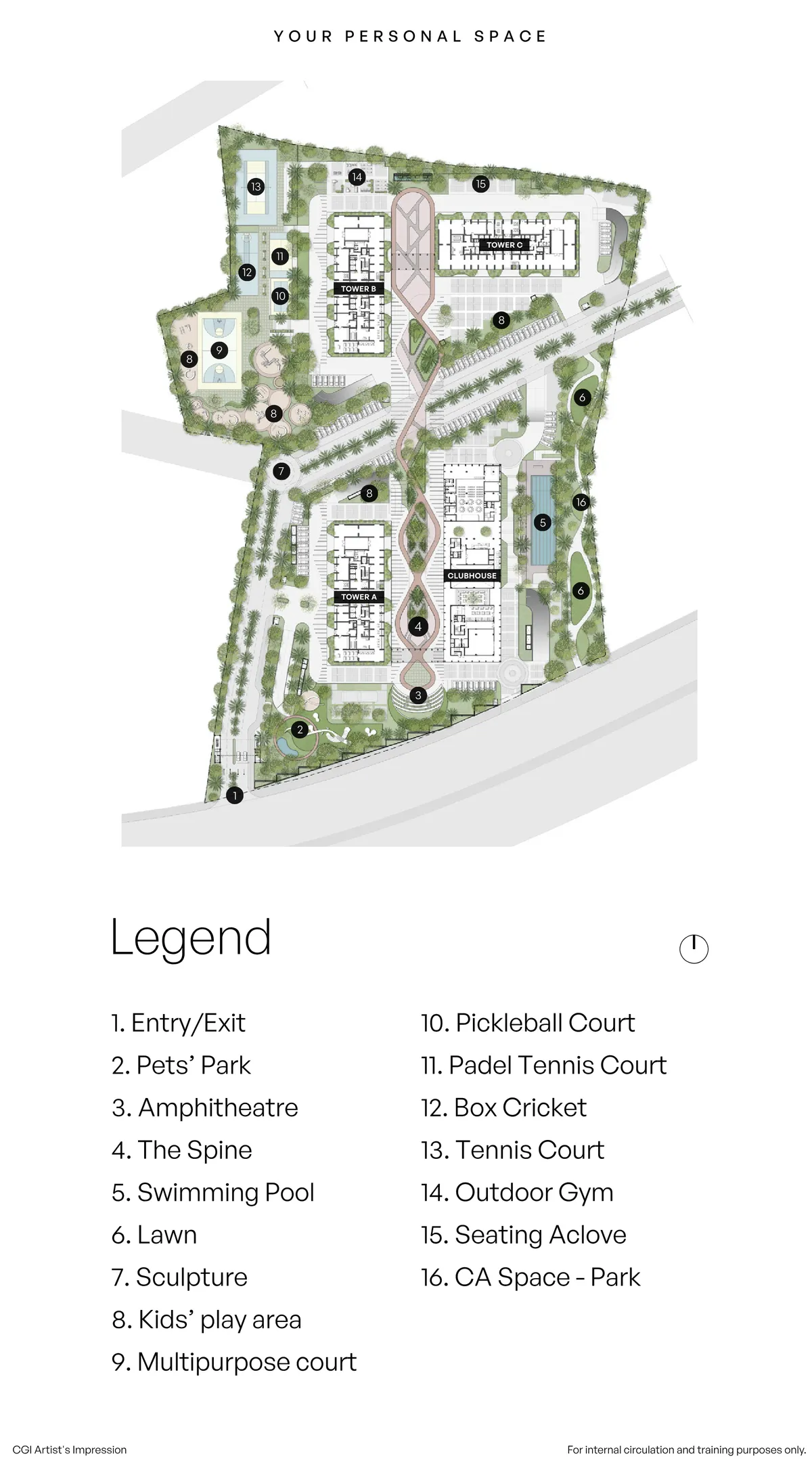
Site Planning Philosophy: Open Space as the Foundation
The master plan of Assetz Sublime Hoskote is built around a single, powerful organising principle: the 81% open space ratio. On 11.6 acres of land beside Old Madras Road (NH-75) in Hoskote, East Bangalore, this ratio translates into a development where buildings cover about 15% of the plot at ground level - under one-sixth of the site. Everything else - gardens, walking paths, sports courts, play areas, seating alcoves, the landscaped spine, and buffer zones - is dedicated to the outdoor environment that residents experience daily. For another Bengaluru planning reference, Assetz Twin Lake City helps keep attention on density, circulation, landscape depth, and the way residents will move through the community.
This is not a trivial design decision. In land-constrained markets like Bangalore, many developers maximise saleable area by pushing the open space ratio toward the regulatory minimum. Assetz has taken the opposite approach, using the generous land parcel to create a living environment that feels closer to a landscaped estate than a conventional apartment complex. The result is wider inter-tower distances, more mature tree planting, greater separation between active amenity zones and residential quiet zones, and a general sense of spatial luxury that drawings cannot fully convey.
Tower Placement and Orientation
The three towers are positioned along the periphery of the site, a planning strategy that pushes built structures to the edges and liberates the central zone for landscaping and amenities. This peripheral tower placement achieves several important objectives.
First, it maximises the contiguous open area at the heart of the development, allowing the landscaped spine and central amenity cluster to function as a unified green campus rather than a collection of disconnected pockets. Second, it ensures that every tower has outward-facing units with views beyond the site boundary, reducing the feeling of enclosure that can occur when towers are positioned inward. Third, it provides clear sightlines from the towers toward the central gardens and amenity areas, connecting residents visually with the green campus even from upper floors.
Towers B and C rise to ground plus 32 floors over two basements, and Tower A - cleared at ground plus 8 - is planned at ground plus 36; the retail and amenity blocks are low-rise, at ground plus 2. Inside each tower the deck commits to five lifts per core and a double-height entrance lobby that it says is "built to evoke grace and grandeur". Approach to the campus itself is through a gateway that the deck describes as an architectural masterpiece of wooden-finish aluminium louvers, screening the drive-in from the highway edge and setting up the tiered landscaping that steps down from the arrival court into the central gardens.
The land is in the Hoskote taluk planning area of the Bangalore Metropolitan Region Development Authority (BMRDA), outside the Bengaluru city corporation's limits, so the approvals that will eventually fix this layout are BMRDA layout and building sanctions. That is worth knowing before you read any pre-launch drawing as final.
The 16-Point Master Plan Legend
The legend printed on the developer's conceptual master plan numbers sixteen zones. Reading them in order gives you the clearest picture available today of how the 11.6 acres are apportioned:
- 1. Entry / Exit - the single controlled gate serving the whole campus.
- 2. Pets' Park - a fenced run set away from the children's zones.
- 3. Amphitheatre - stepped outdoor seating for community events.
- 4. The Spine - the landscaped pedestrian corridor that links the rest.
- 5. Swimming Pool - the temperature-controlled pool, in the clubhouse cluster.
- 6. Lawn - the open green that reads as the campus's main soft surface.
- 7. Sculpture - a landscape focal point on the spine.
- 8. Kids' play area - age-designated play, per the deck.
- 9. Multipurpose court - the flexible hard court.
- 10. Pickleball Court
- 11. Padel Tennis Court
- 12. Box Cricket
- 13. Tennis Court
- 14. Outdoor Gym - open-air equipment within the garden setting.
- 15. Seating Alcove - the informal gathering pockets along the spine.
- 16. CA Space - Park - the civic amenity parcel, shown as park.
Items 9 to 14 sit together as the sports cluster, which is why the deck's headline claim of more than twelve sports facilities is plausible on a site this size once indoor facilities in the clubhouse are counted alongside them. Items 2, 6, 7 and 15 are the quiet counterweight. Everything here is drawn from the developer's own pre-launch material and should be read as indicative.
The Landscaped Spine
Running through the development like a green boulevard, the landscaped spine is the primary organising element of the outdoor environment. It connects the main entry, the clubhouse zone, the sports courts, and the garden areas in a continuous pedestrian-friendly corridor that encourages walking, cycling, and outdoor socialising.
The spine is designed with varied landscape treatments - tree-lined sections, open lawn areas, paved gathering nodes, and seating alcoves - that create distinct character zones as you move through it. This variety prevents the monotony of a single landscape type and ensures that different parts of the spine serve different social and recreational functions. A section near the clubhouse might be more active and social, while a section at the far end of the campus might be quieter and more contemplative.
Seating alcoves along the spine provide informal gathering spots that encourage spontaneous interaction between residents. These are not afterthought benches placed on leftover land. They are purpose-designed landscape elements that contribute to the social fabric of the community.
The Clubhouse and Central Amenity Zone
The 32,000 sq ft corten steel clubhouse sits at the social and recreational heart of the master plan. Its central position ensures equitable access from all three towers, while its architectural expression - the distinctive corten steel cladding that weathers to a rich patina over time - establishes it as a visual landmark within the development.
The clubhouse zone extends beyond the building itself to include the temperature-controlled swimming pool, surrounding pool deck areas, and a cluster of outdoor sports courts. The spatial relationship between the clubhouse interior and the pool and court areas is designed for seamless indoor-outdoor flow, allowing residents to move between gym sessions, pool time, and court games without crossing vehicular roads or navigating disconnected pathways.
Adjacent to the clubhouse, co-working spaces provide a professional work environment for residents who work from home or need a quiet, well-equipped space outside their apartment. This amenity is increasingly relevant as remote and hybrid work patterns become permanent features of professional life. See the amenities page for the full facility breakdown.
Sports and Recreation Zone
The master plan allocates dedicated areas for sports facilities, positioned to balance accessibility with noise management. Active sports courts - including padel tennis, pickleball, tennis, badminton, squash, box cricket, and a multipurpose court - are clustered in a zone that is accessible from all towers but buffered from the quieter residential areas by landscaping and distance.
This zoning approach ensures that the energy and noise of active sports do not intrude on the tranquillity of the garden areas and seating alcoves. It also creates a sense of destination: heading to the sports zone is a deliberate activity rather than something that happens by default because the courts are squeezed between buildings.
The outdoor gym is positioned to take advantage of the garden setting, offering an open-air workout environment surrounded by greenery. Age-designated play areas are distributed across the campus to ensure that children of different age groups have appropriate and safe play environments within easy reach of their tower.
Retail Convenience Zone
The developer's deck sets aside approximately 22,500 sq ft of what it labels "convenience" and describes as "grocery, cafés and essentials seamlessly integrated into everyday living". Positioned for easy access from all three towers, this zone is intended to carry the routine errands - groceries, pharmacy, laundry, food and beverage - without residents leaving the campus. On a site where the nearest organised retail of any scale is Orion UPTOWN Mall, which the same deck puts at an 18-minute drive, an on-campus convenience floor plate of that size is a meaningful part of the daily-living case rather than a decorative line item.
The retail zone's placement within the master plan is carefully managed to ensure that it serves the community without generating traffic, noise, or visual clutter that would compromise the residential character of the development. Deliveries and servicing are routed through dedicated pathways that are separated from the primary pedestrian circulation.
Vehicular and Pedestrian Circulation
The master plan separates vehicular and pedestrian circulation at the site planning level. Vehicles enter the campus through a controlled access point and are directed to basement parking levels beneath the towers. Once a vehicle is parked, the resident's journey continues on foot through the pedestrian-only campus, which is entirely free of vehicular traffic apart from emergency and service access routes.
This separation is essential for safety, particularly for families with children, and for maintaining the environmental quality of the central gardens and amenity areas. It also means that the landscaped spine, seating alcoves, and garden pathways can be designed without vehicle-width constraints, allowing for narrower, more intimate pedestrian routes and more generous landscape treatment.
The legend shows a single entry and exit point at position 1, so the separation between resident and visitor movement happens immediately inside the gate: residents drop into the basements beneath their own tower, while visitor and service vehicles are held at grade near the arrival court and never cross the pedestrian campus. Two basement levels run beneath the towers; the cleared scheme provides 939 car parks for its 576 homes, 144 of them with EV charging. Each tower's double-height lobby is the transition point between the parking levels below and the landscaped campus at grade.
Key Master Plan Metrics
The land area is as cleared on 23 March 2026; the open-space, clubhouse, retail and lift figures are the developer's pre-launch material, which it presents as indicative.
To understand how the individual apartment layouts fit within the tower floors, visit the floor plans page. For a broader view of the project's location context, see the location page.
Want to Discuss the Master Plan?
Our team can walk you through the site layout, tower orientation, and amenity positioning in detail.
Schedule a DiscussionAssetz Sublime Hoskote Master Plan - Frequently Asked Questions
What is the master plan footprint for Assetz Sublime Hoskote?
11.6 acres, three towers and about 800 homes planned - 576 of them cleared in March 2026 - with buildings covering about 15% of the plot and roughly 81% left open. Towers B and C rise to ground plus 32 floors; Tower A is planned at ground plus 36.
How are the three towers placed on the site?
Tower placement is peripheral - buildings are pushed toward the edges of the site to free the central zone for the 32,000 sq ft clubhouse, swimming pool, sports courts, and landscaped spine. This planning move is what makes the 81% open-space figure work in practice.
What is the 'landscaped spine' in the master plan?
The landscaped spine runs through the development as both visual anchor and functional corridor, connecting the clubhouse, garden areas, and sports zones via pedestrian pathways. Seating alcoves and tree planting are integrated along its length.
Does the master plan include any retail or commercial space?
Yes - a 22,500 sq ft integrated retail convenience zone is part of the master plan, positioned for easy access from all three towers. Service and delivery routes are kept separate from pedestrian circulation.
Why is the 81% open-space ratio significant on the master plan?
Most Bengaluru apartment masterplans push more units per acre, so an 81% open-space allocation translates into wider inter-tower distances, more mature landscaping, and genuine buffer zones between active amenities and residences. It is the metric that defines the site's character.
When will the formal Assetz Sublime Hoskote master plan be public?
The formal references will be the plan sanctioned by BMRDA, the Bangalore Metropolitan Region Development Authority, whose planning area covers Hoskote taluk, and the approved layout filed at RERA registration. Neither exists in the public domain yet; the project is not registered with Karnataka RERA as at 21 September 2026. What circulates today is conceptual pre-launch material that Assetz marks as indicative.